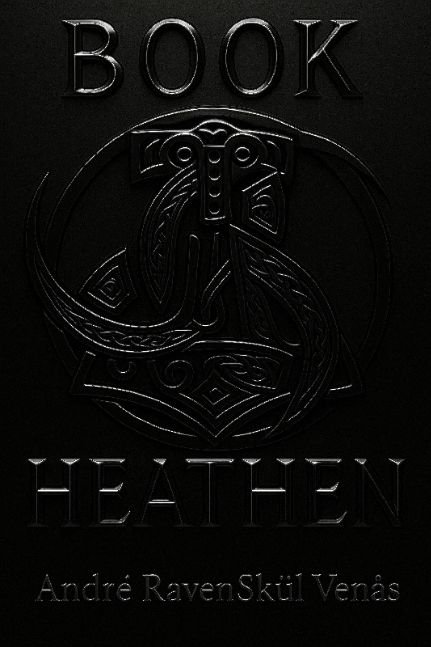
Book of Heathen
$9.99
$25.00
$9.99
About
Book of Heathen is a return to the oldest fire humanity ever tended...
the fire of story, of memory, of ancestral breath carried through frost and thunder. This is not a mere compendium of Norse myth; it is a reconstruction of the worldview that beat beneath the ribs of a people who lived by axe-edge dawns and starlit seas. It is a work that treats myth not as museum artifact, but as living marrow, something that still hums in the blood of anyone who listens long enough.
The journey begins in the raw formlessness of Ginnungagap, where fire and ice collided to ignite existence. From these first collisions; cosmic, chaotic, and violent, the world takes shape: Ymir rising from venomous frost, Auðumbla lapping gods from salt, and the sons of Borr building the world from the corpse of a giant. This opening myth sets the tone of the work: creation is not gentle. Life, as the heathens saw it, is forged under pressure, welded by opposing forces, hardened by necessity.
The book then descends into the philosophical backbone of the Norse mind; the Nine Noble Virtues. Honour, Truth, Courage, Steadfastness, Fidelity, Hospitality, Industriousness, Self-Reliance, and Discipline are presented not as rules, but as survival instincts refined into moral iron. Each virtue is rendered with an understanding of how it functioned within the tribal web of the old North. Honour is the fame that outlives flesh. Truth is weapon and shield. Courage is marrow. Fidelity keeps clans alive through winter. Hospitality keeps strangers from becoming enemies. Industriousness keeps death from the door. Discipline steers the soul. Each virtue becomes a lens through which the rest of the book can be read.
Where most texts end with virtues, Book of Heathen continues deeper, to the metaphysical engines of the Norse cosmos: Örlög, Wyrd, and the Hamingja. These are the unseen laws older than the gods themselves. Örlög is the primal law; the root-pattern laid down by past deeds. Wyrd is the turning of all things, the becoming. Hamingja is the luck-soul of a lineage, inherited and strengthened through action. Together they form a system that is neither fatalistic nor free-willed, but a braided tension between what has been and what may yet be shaped.
This leads naturally into the Viking Ethos, presented not as the pop-culture fantasy of berserkers and brutality, but as a living moral code. The ethos described here is structured around humility, loyalty, mutual obligation, and righteous strength. It dismantles modern misconceptions: the heathen warrior was not a marauder, but a protector bound by oaths, by kinship, by sacred reciprocity. Violence is framed as duty, not impulse; courage as responsibility, not recklessness. A warrior is expected to lift the weak, honour the guest, and restrain the hand until justice, not ego, demands otherwise. The ethos becomes the living expression of the Nine Virtues, tested in frost and fire.
Where many books would pause at philosophy, Book of Heathen continues into the beating heart of Norse spirituality, exploring the numinous; the divine as experienced in terror, awe, and wonder. The gods are presented not as omnipotent rulers, but as “the poles of the cosmos,” forces that uphold reality itself. They rise with creation and fall with it. Their power is immense, but limited; their struggles mirror human struggles; their wisdom is often won through suffering.
This leads into the legendary material: the myths themselves. Rather than summarizing them clinically, the book retells them in full narrative richness. From Óðinn’s self-sacrifice upon Yggdrasill, to the war between Æsir and Vanir, to the forging of treasures, the theft of Iðunn’s apples, Þórr’s duels, Freyr’s tragic courtship, Baldr’s death, Loki’s bindings, and the final march toward Ragnarök, the sagas unfold like fireside recitations.
Each myth is chosen not merely for entertainment, but to illuminate a piece of Norse theology, psychology, or social worldview. Óðinn’s ravenous hunger for knowledge reveals the cultural reverence for cunning and perseverance. Þórr’s unyielding battles express the tension between order and chaos. Loki’s shifting roles expose the perilous edge between creation and destruction, genius and treachery. The death of Baldr reveals the inevitability of loss. Ragnarök shows the cyclical nature of destruction and rebirth, the acceptance that even gods fall and yet the world rises again.
The book continues with a sweeping survey of the gods themselves, rendered more thoroughly than in most modern works. Óðinn as All-Father and wanderer of wisdom. Frigg as keeper of hidden knowledge. Þórr as protector and thunder itself. Loki as both the necessary destroyer and the cosmic wild card. Freyja as lover, warrior, magician. Týr as oath-keeper. Hel as stern but fair queen of the dead. Fenrisúlfr and Jörmungandr as embodiments of apocalypse. Freyr as peace-lord whose sacrifice foreshadows the world’s doom. Each deity is connected to myth, culture, etymology, and ritual meaning.
From here the book branches outward into the Nine Worlds of Yggdrasill, each realm steeped in lore and symbolic meaning. Ásgarðr, Vanaheimr, Álfheimr, Jötunheimr, Helheim, Miðgarðr, and more are painted with the texture of both mythic geography and spiritual psychology, showing the Norse cosmos as a system of relationships, not isolated places.
The last third of the book becomes historical, transforming from scripture to saga to scholarship. It presents the Elder Futhark runes, the Days of Honour, and a wide-ranging exploration of Norse culture, including customs, law, magic, ritual, and daily survival. It then expands into a richly detailed chronicle of famous Vikings and battles, from Ragnarr Loðbrók to Björn Ironside, from the raids on England to the great sea battles of medieval northern Europe.
What emerges is not a book, but a cathedral of heathen knowledge. A work that blends myth, anthropology, theology, linguistics, history, and philosophy into a single voice; stern, poetic, and vast. It is both faithful to the old sources and accessible to modern seekers. It neither glorifies nor sanitizes, but presents the Norse worldview as it was: harsh, beautiful, fatalistic, yet fiercely life-affirming.
Book of Heathen is a guide, a gateway, a story-hoard, and a teacher. A bridge between the modern soul and the ancestral fire. It invites the reader to walk the old paths, not as a tourist, but as one who remembers.
Sample Chapters


Language - English
Publisher Name - KraKRabiT Studios
Publisher Year - 2019
ISBN-13 - 9798807088215