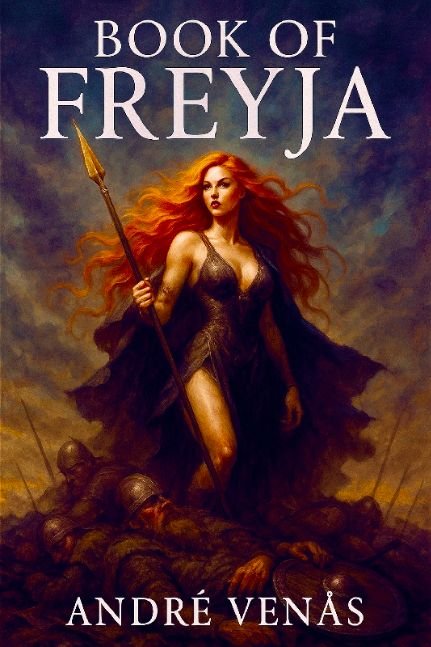
Book of Freyja
$4.99
$13.00
$4.99
About
The Book of Freyja is a doorway, not a destination; an illuminated threshold carved from gold, shadow, and ancient breath. It is not merely a retelling of Norse myth, nor a devotional manual for the modern seeker, nor a scholarly recounting of pantheons and wars. It is a living thing, a pulse rising from the marrow of the North itself, a manuscript that inhales myth and exhales revelation. To open these pages is to enter Fólkvangr, the field of the fallen, where the goddess Freyja keeps her hall and gathers those who died with courage still warm in their blood. It is to walk beside the most complex and misunderstood deity of the Norse world; lover, warrior, seeress, sorceress, wanderer, queen and to feel the fierce rhythm of her stories beat against your own sternum.
Freyja has always lived in the paradox of flame and frost, tenderness and wrath, beauty and unyielding will. She is the Shining One, Vanadis, the Mistress of Seiðr, the shape-shifting, trance-deep magic she once taught even Óðinn, the All-Father. Her face is mirrored in every human contradiction: strength braided with vulnerability, longing intertwined with sovereignty, desire fused to grief. In these pages, she is restored to her original depth, drawn from her mythic roots rather than the softened shadows left behind by later ages.
This book is a tapestry woven of myth, prayer, ritual, and story. It begins with the gateway text Enter Fólkvangr, an invitation that dissolves the distance between reader and goddess. From there, the chapters unfurl into an exploration of Freyja as she was known in the earliest tellings: a figure who crossed worlds without apology, who wept amber tears for her lost husband Óðr, who rode into battle at the head of Valkyries, who commanded magic powerful enough to tilt the fate of the gods themselves. This section paints her not as an accessory to larger mythic forces but as a sovereign force in her own right, one whose beauty is not decorative but catalytic, a force that reshapes each realm she touches.
Her stories are retold here with fire and fidelity. You will walk through the great cosmic war between the Æsir and Vanir, the clash that reshaped the Nine Worlds in “The Tale of Æsir and Vanir.” This sweeping narrative restores Freyja’s central role in the ancient conflict, from her capture in Jötunheimr through deception, to her disguise as Gullveig, to the fire that could not kill her. You will see how the poison of greed seeped through Ásgarðr because of her disguise, how she sparked the cataclysmic war, and how her return forced both tribes to confront their own shadow. The war is told in vivid detail here; arrows hissing through the air, mountains torn from their roots, spells twisting the battlefield, and the uneasy peace that finally formed from their shared blood. These sections read not like dry mythology but like lived history, laden with motion, color, and consequence.
Among these grand sagas are more intimate tales, such as The Tale of Freyja and Ottr, in which a simple man, hopeless in his genealogical ignorance, calls on Freyja for aid. The goddess, drawn by his honest devotion, intervenes in ways that ripple far beyond a humble inheritance dispute. This story, like many in the collection, shows the goddess as she walks among mortals, not as an untouchable deity but as a presence deeply concerned with sincerity, courage, and the sacred weight of promises. Freyja rewards devotion, but she also expects it. She is not a soft goddess; she is a just one.
Ritual practitioners will find great value in the chapters detailing her magic. Freyja’s Rune reveals the energetic architecture behind the Witches’ Rune, tracing how each directional call, each element, each tool becomes a vector for the goddess’s influence. These pages describe not only the symbolic associations of Freyja’s runes; Fehu, Kaun, Inguz, and others, but the visceral sensations, the psychological echoes, and the spiritual dynamics they awaken. Here, the manuscript explores elemental magic, trance work, and the raw power behind the feminine current that Freyja embodies.
The section Rituals for Freyja guides readers into her devotional practice with clarity and reverence. It outlines traditional offerings; berries, honeycomb, wine, flowers and explains how they align with the agricultural and sensual aspects of her nature. It teaches the ethics of working with a goddess who expects exchanges to be sincere and reciprocal. It warns that vague promises leave practitioners vulnerable to unexpected lessons, for Freyja is a goddess who honors honesty and disdains half-heartedness. And it instructs on timing rituals with the cycles of moon and season; particularly Friday, her sacred day, which still bears her influence in the modern tongue.
The book also includes prayers; raw, heartfelt pieces that evoke Freyja’s presence with a vulnerable, devotional intimacy. These prayers are woven throughout the narrative, each one a beacon for readers seeking connection with the divine feminine. They highlight Freyja as goddess of love, lust, beauty, gold, witchcraft, war, death, transformation, and rebirth. The text shows her not as an abstract force but as a living, breathing being who listens, responds, guides, and reshapes.
Beyond mythological retellings and ritual instruction, The Book of Freyja dives deep into cosmology, philosophy, and the metaphysical frameworks underlying Norse magic. It explains Seiðr not as a theatrical trick but as an ancient technology of soul and intention; one that bends fate’s threads, communicates with spirits, and alters the architecture of the unseen. It portrays the Völva, the wandering seeress, with respect and nuance, preserving the cultural context of her power and the ancestral memory of her craft.
In its final chapters, the book explores the tapestry of signs, runes, and symbols tied to Freyja; amber, cats, strawberries, myrrh, mistletoe, daisies, boars, the feather cloak, Brísingamen, and more. Each symbol is examined for its magical resonance, mythic lineage, and emotional truth. This symbolic lexicon allows readers to understand how Freyja’s presence lingers in modern culture, language, and landscape.
Ultimately, The Book of Freyja is not simply about a goddess. It is about the reclamation of the sacred feminine in all its ferocity and softness. It is about learning how to stand tall in one’s own contradictions, how to wield beauty without apology, how to grieve without collapsing, how to love fiercely yet remain sovereign. It is about remembering that power and tenderness are not opposites, they are mirrors. Freyja was never a goddess who bowed. She was a goddess who burned.
This book invites readers to do the same.
Sample Chapters


Language - English
Publisher Name - Norse Vitki Incorporated
Publisher Year - 2020
ISBN-13 - 9798628742174